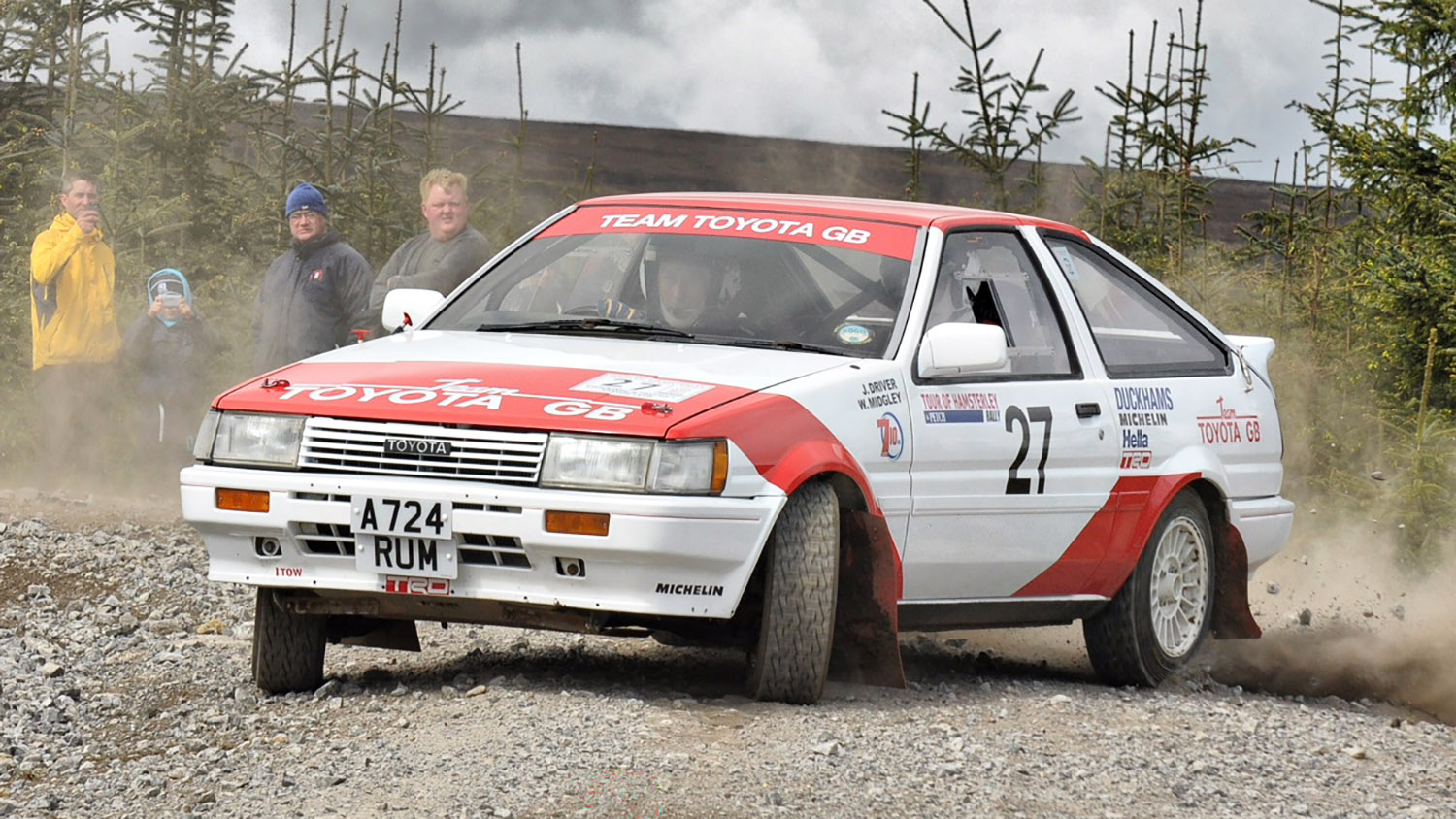
BUYER’S GUIDE
Toyota Corolla AE86 review
A hero car for gamers, drifters, racers and rally drivers alike, the Toyota AE86 proves humble roots are no barrier to legend status…

Engine
1.6-litre four-cylinder petrol
Power
130PS (95kW) @ 6,600rpm
Torque
149Nm (110lb ft) @ 5,200rpm
Kerb weight
970kg
0-62mph
8.3 seconds
What Is It?
A small car with a huge legacy, the Toyota Corolla AE86 has long-since transcended origins as a grassroots performance car for budding racers, drifters and rally drivers, and evolved into a standard bearer for the Japanese car culture exported to the world through Gran Turismo, Best Motoring video shootouts and more. Conceived as a sporting variant of the fifth-generation Corolla, the catch-all AE86 designation covers a family of cars sharing common foundations of a revvy 1.6-litre engine, live-axle rear-wheel drive layout and lively handling while marketed under a variety of names according to the market in which it sold.
While this included Europe and the UK, the AE86’s heart and soul remains rooted in the Japanese Domestic Market (JDM) car scene, be that through its role in the illicit drifting and Töge mountain races through to more official motorsport success on circuit and rally stage alike. An absolute riot to drive, the AE86 proves simple underpinnings and modest power are no barrier to fame and fortune, this reputation meaning values are only going one way.
Corrosive Areas

Sunroof surrounds

Sills and suspension mounts

Spare wheel well
Checklist
- AE86 launched as a sporting variant of the front-wheel drive fifth-generation Toyota Corolla, but based on the rear-wheel drive running gear of the previous version
- The variety of branding under which it sold in different parts of the world can get confusing; British and Irish market cars sold as Corolla GTs and in liftback form only
- JDM versions came in two distinct flavours, the Levin or pop-up headlight Sprinter Truenos, both available in two-door coupe or liftback bodies
- Many of the cars now in the market will have JDM roots, so it’s worth familiarising yourself with these Japanese models and trims
- Whichever you’re going for, ‘AE86’ or ‘Hachi-Roku’ (after the Japanese for ‘86’) has become a catch-all name, though it’s worth pointing out this only refers to the twin-cam cars, the more basic single-cam variants officially AE85s
- Although on sale for a relatively short time, production is divided into ‘zenki’ early models built 1983-1986 and the 1986-1987 ‘kouki’ versions
- Differences are mainly cosmetic, though an electronically-controlled automatic was added as an option on kouki models — you’ll be wanting the manual for the full experience, though!
- JDM trims comprised GT (two-door coupe only), GTV (liftback only) and top-spec GT Apex
- Standard spec was pretty basic, the limited-slip diff a desirable option; power steering was also an extra, the non-assisted set-up heavy at low speeds but beautifully communicative once moving
- If you’re buying sight unseen from an importer be sure you know what you’re getting, and be especially wary of single-cam AE85s masquerading as twin-cam 86s
- While mechanically tough, rust and crash damage are going to be your two main concerns, so whether inspecting in the metal or in an online report look for signs of repairs and corrosion
- Don’t look past missing exterior or interior trim pieces — given the myriad of market-specific models sourcing the correct replacement parts could be tricky if you’re chasing originality
- Non-stock steering wheels, additional gauges bodged onto the instrument cluster, bodykits of varying quality, different wheels, aftermarket suspension kits and more are common — this is all part of the fun for some buyers and fine if done sympathetically but beware DIY bodges
- Toyota has restarted limited production of certain AE86 specific parts to support owners through its GR Heritage Parts programme — these are available through regular dealerships on a while-stocks-last basis and include bearings, wiring looms, driveshafts and more, cylinder blocks and heads recently added to the catalogue to support mechanical rebuilds and tuning
How does it drive?
Proof, were it ever needed, that modest power and relatively basic foundations are no barrier to fun at the wheel, and from rally stages to roundabouts a well-sorted AE86 is an absolute scream. Possibly for the wrong reasons if you’re not a dab-hand with the opposite lock. Though, to be fair, going sideways comes so naturally you’ll feel as comfortable viewing the road ahead through the side windows as the windscreen in no time!
Even in standard form the bark of the twin-cam 1.6-litre engine and its lust for revs is addictive, the positive shift of the five-speed gearbox and sharp steering response providing the perfect building blocks for fun at all speeds. Even serious ones, as grainy videos from back in the day of ‘Drift King’ Keiichi Tsuchiya (literally) smoking Skylines in his personal Sprinter Trueno go to prove.
What’s good?
Whether your reference point is through clubman rallying, ‘80s BTCC, Best Motoring shootouts, Initial D’s Manga depictions of a street racing teenager or through Gran Turismo, the AE86 resonates with a broad petrolhead demographic. Many now seeking to live the dream for real and unlikely to be disappointed by the experience at the wheel of the real thing.
The fact this comes in a Corolla dating from Toyota’s peak ‘beige’ era only adds to the intrigue, these humble roots giving the AE86 true everyman appeal. This will only grow with increasing recognition and values are only going one way, whether preserved in original form or sympathetically modified to fit with your motoring tribe, of choice. The fundamental mechanical simplicity and inherent Toyota toughness also count in its favour.
What’s bad?
You’ll have to contend with side-eyes from the more trad end of the classic car scene when you try and convince them a humble 1.6-litre Corolla is as covetable and valuable as more exotic alternatives. And, true, the interior is very much ‘80s Toyota in its plastics and velours, but snobbery is more their problem than yours. More practically speaking the biggest issue will be in sourcing one at a sensible price, given the bigger crowd of people chasing a diminishing and increasingly expensive pool of potential purchases.
Many of which will already have led hard lives, given the popularity among modders, wannabe drifters and ‘enthusiastic’ drivers of all hues. Enduring popularity on the rally scene has also hoovered up a lot of suitable project cars, especially UK and Irish market ones. And if that hasn’t done for availability, crash damage and rust will have finished the job, the fact much of the expertise, parts and support comes from the other side of the world means restoring or even just running an AE86 is going to throw up challenges you wouldn’t face with the equivalent Mk2 Escort.
Which model to choose?
While they all share a common character, your main aesthetic choices are the pop-up headlight Sprinter Truenos or more conventional Corolla Levins, and between the two-door coupe and ‘liftback’ hatch bodystyle. If you confine your search to UK or Irish market right-hand drive Corolla GTs that does at least limit the choice to Levin-based fixed-light hatchbacks. Whichever your chosen look, the real challenge will be tracking down an unmolested and non-rusty example free of battle damage and/or dodgy mods inflicted by previous owners. Which is especially tricky given the lives most AE86s will have led, wherever in the world they hail from. Casting that net to include imports from right-hand drive markets like Japan and Australia at least increases the potential choices, the liftback perhaps the better looking of the two if it were our money.
Specifications
Engine
1.6-litre four-cylinder petrol
Power
130PS (95kW) @ 6,600rpm
Torque
149Nm (110lb ft) @ 5,200rpm
Transmission
Five-speed manual, rear-wheel drive
Kerb weight
970kg
0-62mph
8.3 seconds
Top speed
122mph
Production dates
1983-1987 (all variants)